Media Summary: This is an introduction to the Binomial Theorem which allows us to use binomial coefficients to quickly determine the expansion of ... We start with a bit of review of sigma notation and some understanding of exactly what the binomial theorem is all about before ... The definition and properties of divisibility with proofs of several properties. Formulas

Discrete Math 6 4 1 - Detailed Analysis & Overview

This is an introduction to the Binomial Theorem which allows us to use binomial coefficients to quickly determine the expansion of ... We start with a bit of review of sigma notation and some understanding of exactly what the binomial theorem is all about before ... The definition and properties of divisibility with proofs of several properties. Formulas There are a number of properties that might be possessed by a relation on a set including reflexivity, symmetry, and transitivity. discretemathematics Join what's app group ... Welcome to FixMyQuery — Your one-stop solution hub

Please see the updated video at The full playlist Building a valid argument using rules of inference

Photo Gallery

Discrete Math - 6.4.1 The Binomial Theorem
Discrete Math II - 6.4.1 The Binomial Theorem
Discrete Math - 4.1.1 Divisibility
6 4 1 Grade 6 Unit 4 Lesson 1 Morgan - Open Up Resources
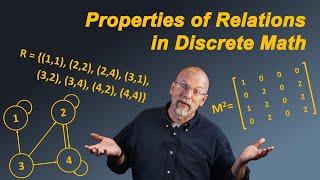
Properties of Relations in Discrete Math (Reflexive, Symmetric, Transitive, and Equivalence)
Discrete Math - 6.1.1 Counting Rules
Exercise # 6.4  Q1,2,3 ( Binomial Expansion)|| Rosen Discrete Mathematics 7th Edition|| M.Owais
Discrete Mathematics(Rosen7th edition) |Chapter 1 | Textbook Ex 1.5 Q1 to Q25 Solution | FixMyQuery
Discrete Math 6.1.1 Counting Rules
Discrete Math - 1.6.1 Rules of Inference for Propositional Logic
View Detailed Profile
Discrete Math - 6.4.1 The Binomial Theorem

Discrete Math - 6.4.1 The Binomial Theorem

This is an introduction to the Binomial Theorem which allows us to use binomial coefficients to quickly determine the expansion of ...

Discrete Math II - 6.4.1 The Binomial Theorem

Discrete Math II - 6.4.1 The Binomial Theorem

We start with a bit of review of sigma notation and some understanding of exactly what the binomial theorem is all about before ...

Discrete Math - 4.1.1 Divisibility

Discrete Math - 4.1.1 Divisibility

The definition and properties of divisibility with proofs of several properties. Formulas

6 4 1 Grade 6 Unit 4 Lesson 1 Morgan - Open Up Resources

6 4 1 Grade 6 Unit 4 Lesson 1 Morgan - Open Up Resources

Mr. Morgan's

Properties of Relations in Discrete Math (Reflexive, Symmetric, Transitive, and Equivalence)

Properties of Relations in Discrete Math (Reflexive, Symmetric, Transitive, and Equivalence)

There are a number of properties that might be possessed by a relation on a set including reflexivity, symmetry, and transitivity.

Discrete Math - 6.1.1 Counting Rules

Discrete Math - 6.1.1 Counting Rules

Strategies

Exercise # 6.4  Q1,2,3 ( Binomial Expansion)|| Rosen Discrete Mathematics 7th Edition|| M.Owais

Exercise # 6.4 Q1,2,3 ( Binomial Expansion)|| Rosen Discrete Mathematics 7th Edition|| M.Owais

discretemathematics #rosendiscretemaths #bionomial #education Join what's app group ...

Discrete Mathematics(Rosen7th edition) |Chapter 1 | Textbook Ex 1.5 Q1 to Q25 Solution | FixMyQuery

Discrete Mathematics(Rosen7th edition) |Chapter 1 | Textbook Ex 1.5 Q1 to Q25 Solution | FixMyQuery

Welcome to FixMyQuery — Your one-stop solution hub

Discrete Math 6.1.1 Counting Rules

Discrete Math 6.1.1 Counting Rules

Please see the updated video at https://youtu.be/32MnjUdIF0c The full playlist

Discrete Math - 1.6.1 Rules of Inference for Propositional Logic

Discrete Math - 1.6.1 Rules of Inference for Propositional Logic

Building a valid argument using rules of inference